
Introduction
iGaming is no longer just an industry of “content and traffic.” It has become a competition of systems: who can detect risk faster, serve players more efficiently, retain them more precisely, and remain consistently compliant. As a result, technology here is not valued for its “wow factor,” but for three things: margin, operating costs, and resilience to risk.
Below is an analysis of three key areas currently reshaping the economics of iGaming, with practical examples, performance impact, and clear payback horizons.
Regional differences in technology adoption
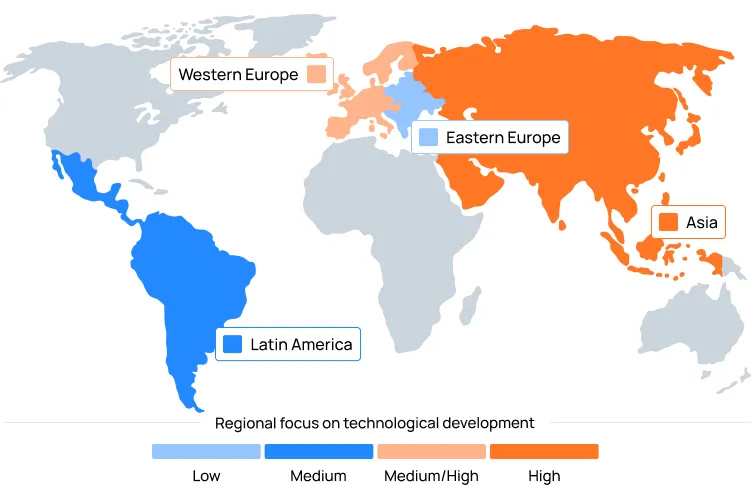
Technological transformation in iGaming is uneven. Priorities depend on regulatory maturity, audience structure, competition, and market scale. A global view shows that different regions prioritize different technologies.
Europe
The European market is among the most mature and tightly regulated. Technology here is primarily focused on compliance and risk management.
Key focus areas:
- AI in Responsible Gambling
- AML and KYC automation
- player behavior monitoring
- transparent regulatory reporting
High penalties and regulatory pressure make investment in AI-driven control and compliance a necessity. In Europe, technology mainly protects licenses and long-term business stability.
Eastern Europe
Eastern European markets have historically faced higher levels of bonus abuse, multi-accounting, and player arbitrage strategies. This has driven strong investment in fraud prevention systems.
Widely adopted solutions:
- advanced anti-fraud platforms
- device fingerprinting
- behavioral biometrics
- automated anomaly detection
The result is high technological maturity specifically in margin protection and risk control.
Latin America
Latin America is a fast-growing market with a young, mobile-first audience and intense competition. The main objective is scaling and retention.
Operators focus on:
- AI-driven personalization
- automated marketing flows
- dynamic segmentation
- churn prediction
Technology here is less about reducing risk and more about accelerating growth and increasing customer lifetime value.
Asia
Asian markets are defined by massive user bases and high mobile engagement. At this scale, manual processes are economically unviable.
Key priorities:
- fully automated onboarding
- scalable payment systems
- automated risk scoring
- AI for support and operations
Technology enables operators to serve millions of users without proportional cost growth.
AI in iGaming
AI operates across four core areas where impact is measurable through clear KPIs: fraud prevention, KYC/AML, responsible gambling, and personalization.
Fraud prevention and risk management
The problem is straightforward: bonuses and payments are the main targets for fraud and abuse. Bonus abuse, multi-accounting, account takeovers, and chargebacks erode margins faster than marketing can recover them
What AI delivers:
- real-time fraud detection
- automation of most verification processes
- fewer false positives, preserving conversion and user experience
Observed outcomes:
- bonus budget leakage reduced by ~43%
- up to 95% automation of checks, blocking up to 90% of fraudulent registrations
- 99.5% detection accuracy with 35% fewer false positives
- in sports betting, nearly 48% of odds trading handled by algorithms in 2025 (vs 4% in 2022)
These solutions typically pay off quickly. Losses decrease immediately while operational workload drops. Payback usually occurs within 3–12 months.
KYC/AML
Compliance is one of the most expensive operational areas, especially in fast-growing markets. Manual KYC does not scale well and quickly becomes a bottleneck.
What AI enables:
- identity verification within seconds
- automation of most cases
- reduced registration drop-off
- freeing compliance teams for complex checks (EDD, fund sources)
Key metrics:
- up to 98% of checks automated in ~6 seconds
- 95% first-time KYC success rate
- onboarding conversion improvements up to +30%
- ~20% fraud loss reduction (Forrester estimate for Veriff)
- manual checks reduced from hours to minutes in real deployments
- up to 85% time savings on enhanced due diligence
The economics are clear: fewer staff required and higher conversion into paying users.
Responsible Gambling
Often seen as a regulatory requirement, Responsible Gambling is also an economic tool, though also dismissed as irrelevant. Early intervention is cheaper than fines, incidents, or forced restrictions.
What AI enables:
- tracks behavioral risk indicators (session length, bet escalation, chasing losses, late-night play, repeated deposits after losses)
- intervenes before behavior becomes harmful
- builds auditable compliance frameworks
Metrics:
- risk detection accuracy up to 97%
- ~€6 million annual savings and 33% reduction in serious incidents in some cases
ROI here is not measured only in cost savings, but also in operators preserving licensing stability and retaining a loyal audience that stays with the product when there are no scandals or reputational setbacks.
Personalization and retention
If anti-fraud and KYC deliver quick wins, personalization builds long-term profit. It works where what matters is not one more bonus, but the right offer made at the right time..
What AI brings:
- dynamic segmentation
- trigger-based lifecycle journeys
- recommendation mechanics tailored to player interests
- churn reduction
For example, Lottomart used an AI-driven CRM to double its active player base in four months through automated lifecycle campaigns.
There is also an additional layer in the form of GenAI assistants for communications and support. NetBet, for instance, launched a generative bot that provided guidance on betting and rules directly during gameplay.
Personalization has a direct impact on retention and customer lifetime value. Even a small uplift in retention can materially increase total profit.
The AI vendor market
In practice, there is no single universal AI solution. The stack is built around specific business needs.
Anti-fraud / payment risk
- SEON: device fingerprinting plus ML scoring, auto-checks up to 95%, blocking more than 90% of fraudulent registrations
- Sift: trained on massive event volumes, with a strong focus on keeping false positives low, which matters for both conversion and trust
KYC / IDV
- Veriff: 98% of checks automated in seconds, with a high first-pass success rate
- HooYu: process orchestration, biometrics, address verification, and video identification
AML / EDD
- Synalogik Scout: speeds up complex checks by up to 85%, reducing routine work and human error
Responsible Gambling
- Mindway AI: behavioral analytics and risk scoring, with proven effectiveness at scale
Selection logic:
- if the goal is to cut direct losses immediately, operators usually start with anti-fraud
- if the goal is to meet regulatory standards and protect reputation, they strengthen KYC/AML and RG
- if the goal is to maximize LTV in mature markets, they add AI personalization and recommendation systems
AR/VR
AR in live casino and game shows has already become an industry standard
AR wins for one simple reason: the barrier to entry is almost zero. The player only needs a smartphone or a browser, while the operator gets stronger engagement through visual layers added on top of the live stream.
Examples:
- Evolution and the live show format, including Monopoly Live and other shows with AR objects and 3D bonus features
- similar approaches used by other live content providers
Advantages of AR:
- no special equipment required
- accessible via smartphone or browser
- increases engagement without making the interface more complex
Implementation costs are moderate, and the effect on engagement and session length is already visible in the current period.
VR casinos: a niche with high potential, but weak payback as of 2026
VR delivers maximum immersion, but it requires dedicated hardware and user familiarity with the format. That limits the audience and makes the business case difficult. Fully fledged VR casinos do exist, but their audience remains limited.
Reasons:
- a VR headset is required
- development costs are high
- the user base is still small
For now, VR projects are closer to experiments and long-term investments. Real payback becomes possible only if the device user base grows.
Pioneer cases:
- SlotsMillion, with a virtual slot hall
- Evoplay, with the VR slot Necromancer
- PokerStars VR, a social VR poker product that is more of a brand play
Efficiency takeaway
- AR is a clear and accessible tool with a positive payback horizon
- VR is an R&D direction whose payback depends on growth in the user base
Cyber threats and protection
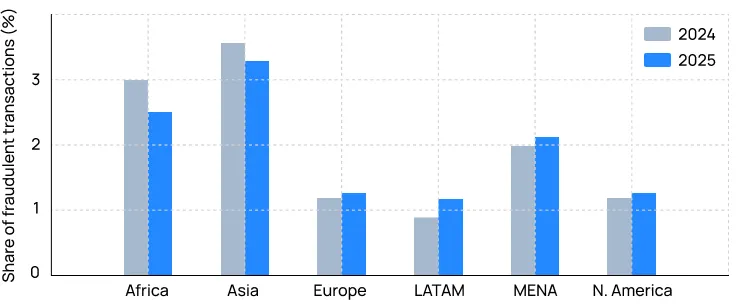
If AI improves efficiency, security is what keeps the business legal and continuously operational. In iGaming, the cost of each incident is usually higher than the potential cost of protection.
Key threats:
- bonus abuse and multi-accounting, which account for about 63.8% of all fraud, with up to 15% of promo budgets potentially going to fraudsters
- ATO and identity fraud, up 43% year over year, with deepfake risks increasing as well
- payment fraud and chargebacks
- DDoS attacks, with frequency up 94% year over year in 2023 to 2024
- data breaches and extortion, for example the MGM case in 2023, with estimated damage of about $100 million
Modern protection methods include:
- behavioral biometrics
- device analysis
- machine learning for anomaly detection
- cloud-based DDoS protection
- automated transaction monitoring
Together, these measures can reduce fraud detection time by 98% and save around 1,000 man-hours per year. Security investments are difficult to measure directly, but the cost of even one serious incident can exceed protection costs many times over.
Payback map: what to implement first
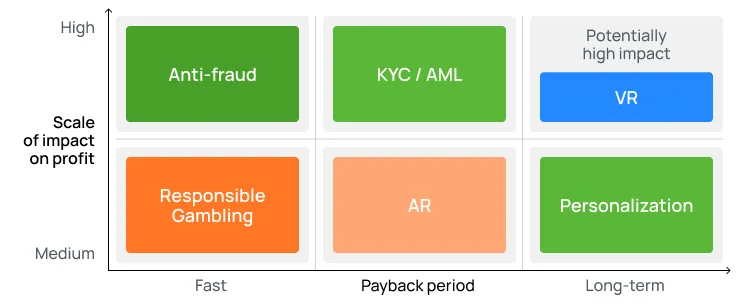
If everything is reduced to practical logic, the rollout sequence by speed of impact looks like this:
- Anti-fraud / risk engine / payment monitoring
Payback: months
Effect: direct losses ↓, team workload ↓, margin ↑ - KYC/AML automation
Payback: up to one year (often faster at scale)
Effect: onboarding conversion ↑, cost-to-serve ↓, compliance resilience ↑ - Responsible Gambling framework
Payback: medium term, but high value
Effect: risk of fines ↓, license stability ↑, long-term LTV ↑ - AI personalization and recommendation systems
Payback: 1–2 years
Effect: retention ↑, LTV ↑, bonus efficiency ↑ - AR features in live / gamification
Payback: around one year with proper integration
Effect: engagement ↑, product differentiation ↑ - VR
Payback: long-term or experimental
Effect: brand/PR ↑, positioning for future device market ↑
Final conclusion
Technology in iGaming shows how predictably an operator manages its system: where money is leaking, where players break during onboarding, where risks are growing faster, and where the regulator expects provable processes.
AI has already proven its value in anti-fraud, KYC/AML, and operational automation. AR is delivering impact today because it is accessible and easy to adopt. VR remains a future option: interesting, but expensive. Security and compliance are no longer just “costs.” They have become a way to protect both profit and licensing.
Between 2026 and 2028, the winners will be those who build their technology stack around their actual priorities: quick wins through anti-fraud and KYC, structural resilience through RG and security, and growth through personalization and product improvements. That is the formula for technological leadership in iGaming. 01.tech has accessible technologies and the experience to solve any challenge that may arise in running an iGaming business.
Share: