
Introduction
The online gambling industry (iGaming) is growing rapidly, bringing increased regulatory focus to Responsible Gaming (RG) and compliance requirements. Operators need to protect players from gambling-related harm while also maintaining healthy business growth. Global best practice today shows that built-in responsible gaming tools and proactive compliance can increase trust and audience retention without materially harming operator revenue. This review looks at: new regulatory requirements in different countries, the effectiveness of existing RG tools, the use of AI for risk assessment, the balance between strict compliance and strong UX, the impact of compliance procedures on conversion and retention, and an up-to-date RGF (Responsible Gambling Framework) model for operators and platforms.
New responsible gaming requirements across jurisdictions
Global tightening of the rules. Regulators around the world are introducing increasingly strict responsible gaming standards. In the UK, for example, a number of restrictions for online slots have been in place since 2021: a minimum spin duration of 2.5 seconds, a ban on autoplay, the removal of “losses disguised as wins” (sounds or effects on wins below the stake), and on-screen display of current losses and time spent playing. According to the UKGC, these measures reduced game intensity (fewer long sessions, fewer high stakes) without lowering player engagement or enjoyment. In particular, there was no compensatory increase in stake sizes due to slower spins, and the share of games with stakes >£2 even fell (from 3.9% to 3.3%). This means that restrictions on speed and visual effects reduce risky behavior without sacrificing revenue or player satisfaction.
The Netherlands has become an example of a hard-line approach: since October 2024, regulator KSA has required operators to set monthly deposit limits — €300 for players aged 18–24 and €700 for players over 24. If these thresholds are exceeded, the player’s ability to afford the spend must be checked, and deposits are blocked until the end of the month if the check is not passed. At the same time, mandatory “real-time” behavioral monitoring has been introduced: the operator must respond within an hour to signs of gambling harm (nighttime marathon sessions of >6 hours, continuous betting, very frequent deposits, etc.). The first results are impressive: the share of players losing more than €1000 per month fell from ~4% to ~1%. Average loss per account dropped by 31% (from €116 to €80). The chart below shows the effect of introducing the limits: the share of “heavy users” and their contribution to revenue before and after regulation.
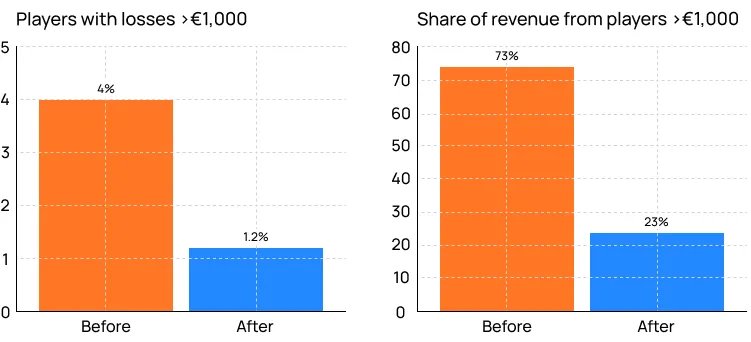
Fig. 1: The effect of mandatory deposit limits in the Netherlands — the share of players with losses >€1000 per month and their contribution to operator revenue before vs. after the rules were introduced. The restrictions significantly reduced the number of excessively active customers and lowered the business’s dependence on their spending (data source: KSA, Gambling Insider).
At the same time, the gross gaming revenue (GGR) of licensed operators fell by only ~8–10% — meaning the market retained its core performance while shedding the riskiest turnover. The regulator notes that 93% of players now play only with licensed operators, but acknowledges the risk of some high-value players moving to offshore sites. This is why the industry is calling for balanced regulation: strict measures should be accompanied by active enforcement against illegal sites, so that high-risk players have no incentive to seek unlimited play on the black market.
North America. Since 2023, the US state of New Jersey has operated an advanced RG program: regulator DGE requires online operators to algorithmically identify players showing signs of problematic gambling and apply multi-step interventions. Collected data on betting patterns, deposits, and sessions is analyzed in real time. If a player hits risk triggers (for example, exceeding a certain deposit threshold, repeatedly canceling withdrawal requests, frequently setting and removing limits, playing very long sessions, etc.), the operator must follow a three-phase protocol:
- Soft intervention: a notification or message informing the player about available responsible gaming tools, with a suggestion to set limits or use support services.
- Education: if the behavior continues, the player is shown an educational video about gambling risks and self-control options.
- Direct contact: if the issue escalates, an RG specialist contacts the player directly and recommends taking a break or seeking help.
This proactive monitoring and hierarchy of actions are gradually becoming the norm. Similar requirements for automated behavior analysis and mandatory checks are being introduced in the Canadian province of Ontario (AGCO requires transaction monitoring for signs of gambling harm) and are being discussed in the new UK gambling bill (the so-called “affordability checks” for players with high spend). As a result, the global regulatory map is filling up with more and more rules: deposit limits (the Netherlands, Belgium, Germany), game-speed restrictions (the UK, Germany, Australia), mandatory checks of player spending and income (the UK is planning threshold-based financial checks), and requirements to integrate early risk detection systems (New Jersey, Ontario, some Australian states). Operators working globally need to adapt products to different jurisdictions while staying within a unified responsible gaming strategy.
The effectiveness of responsible gaming tools
How does the audience perceive RG features? There are concerns that intrusive restrictions will scare away well-intentioned players, but research disproves this. According to a large survey of ~1,200 online players, most regular (non-problem) users view responsible gaming tools positively. Only ≈5% of recreational players have ever left a platform because of “excessive control” from RG. By comparison, churn is much higher among at-risk players: ≈13% of moderate-risk and ≈26% of pathological players left an operator because they felt pressured by RG tools. In other words, negative reactions are concentrated among problem players, while the mass audience accepts protective measures calmly. Researchers conclude that there is no reason to soften RG tools out of fear of losing regular customers. On the contrary, a properly implemented responsible gaming system does not push users toward illegal operators and does not hinder commercial growth.
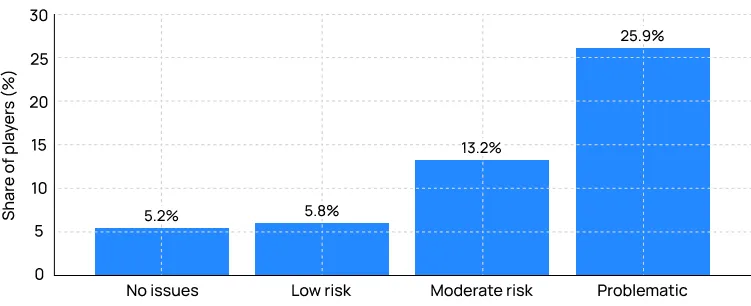
Fig. 2: The share of players who stopped playing with an operator because of “intrusive” RG tools, by risk category (data from a survey of online players). Non-problem players very rarely leave because of Responsible Gaming measures (~5%), while among gambling addicts a quarter left platforms when controls were strengthened.
Which tools work best? Operators note that the tone and design used to present RG features affects their effectiveness. For example, deposit and loss limits are accepted much better when presented as a “personal control tool” rather than a strict top-down ban. Practice has shown that players are more willing to set restrictions when they are built into the interface in a friendly way (budget tips, spend progress indicators, etc.) than when they are framed as a dry regulatory requirement. It is useful to show visualizations of spending: personal statistics, monthly spend charts — these reminders improve self-control without causing irritation. Another tool is session-duration notifications (reality check): unobtrusive pop-up reminders about playing time every X hours. Soft reminders can reduce the length of binge sessions and the amount lost by some players. At the same time, most users perceive them neutrally.
Self-exclusion and breaks are the most important measures for problem players. Their effectiveness increases when the process is easy to access: in a mobile app, the self-exclusion button should be just a couple of taps away, with no need to call support. Best practice includes immediate processing of a self-exclusion request (without waiting several days) and the option to set different break periods (24 hours, a week, a month, etc.). Many modern platforms let players set time-outs for themselves — for example, a “Take a Break” feature disables the ability to play for a selected period in one click.
Regulatory restrictions and their consequences. In addition to tools available at the player’s discretion, direct gameplay restrictions are being introduced for everyone. Alongside the deposit limits and spin-speed restrictions discussed above, some countries also require one click = one bet (to prevent repeat betting), prohibit canceled bets from being returned directly into play, and so on. The goal is to reduce the product’s “gambling intensity.” UKGC data for 2022–23 showed that after the ban on turbo spins and autoplay, average session length fell and the share of very long sessions (>1 hour) decreased. There was no increase in average bet size (stakes did not rise to “compensate” for less frequent spins). Surveys also found no deterioration in player enjoyment metrics. Similarly, in the Netherlands, deposit limits reduced the number of highly loss-making accounts (–75% of players with large losses) without causing a market collapse. Although gross revenue fell by ~10%, this was mainly due to the reduction of excessive losses: the share of revenue coming from players losing >€1000 per month fell from ~73% to ~23%, as already noted. Properly configured RG restrictions therefore protect vulnerable players without preventing the broader audience from playing as usual and spending reasonable amounts.
Share: