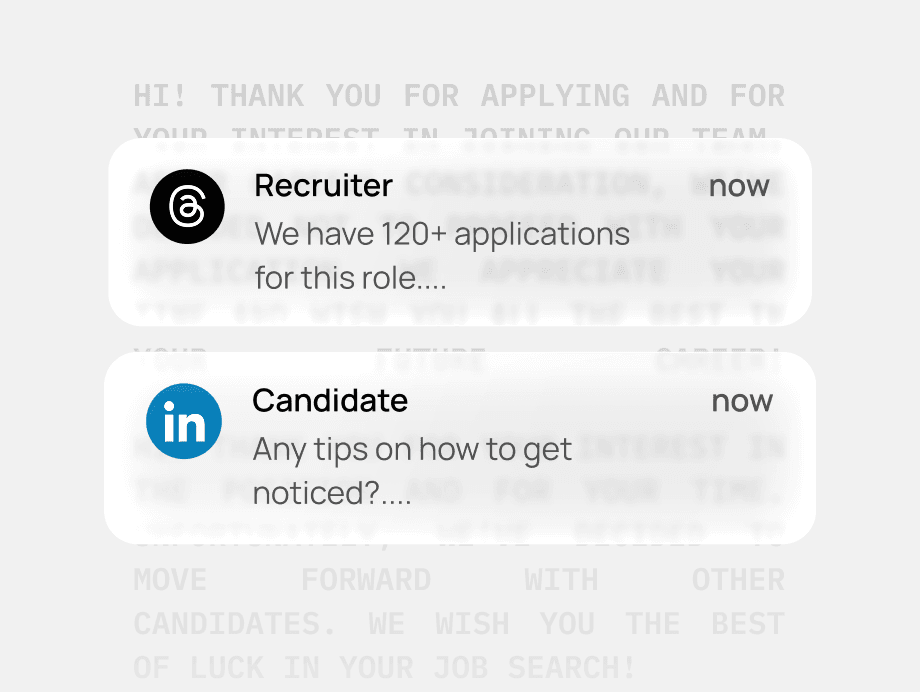
According to LinkedIn, 65% of job seekers say finding a job has become harder. At the same time, 66% of recruiters say finding qualified talent has become more difficult.
How can the same job market have too many candidates and too few of the right ones?
There is no real contradiction. The number of people looking for work and the number of people who actually fit a specific role are two very different things. And over the past few years, the gap between the two has become increasingly visible.
Why more applications don’t make hiring easier
In 2025, around 11,000 applications were submitted through LinkedIn every minute — more than 45% higher than the year before.
One reason is simple: applying for jobs has become much easier.
AI can help candidates find relevant openings, tailor a CV to a job description and draft a cover letter. Tasks that once took considerable time can now be done in minutes.
From a candidate’s perspective, the logic makes sense. If only a small share of applications leads to a response, sending more applications feels like the natural solution.
But when everyone starts doing the same thing, a different problem emerges. Instead of receiving a few dozen applications, companies may receive hundreds from candidates with very different levels of relevance to the role.
So 100 applications do not mean 100 suitable candidates. Application volume is growing much faster than the number of strong matches.
More applications don’t mean more choice
As application volumes increase, recruiters have to decide much faster who meets the core requirements and who should move forward.
From the candidate’s side, the same situation looks very different: more applications are being sent, while the share that receives a response becomes smaller.
And gradually, the cycle reinforces itself:
more applications → more irrelevant applications → stricter initial screening → fewer responses → even more applications.
That is why these two statements can both be true:
“I’ve applied to 100 jobs and barely heard back.”
And:
“We’ve received 100 applications and still haven’t found the person we need.”
There may be plenty of candidates in the market overall, while the pool for one particular role remains surprisingly small. This becomes especially visible in specialised industries, and iGaming hiring is a good example.
Hiring is becoming more specific: what this looks like in iGaming
Companies are increasingly looking beyond a broad set of qualifications towards a very specific combination of experience, skills and domain expertise. The more precise the requirements become, the smaller the number of candidates who genuinely fit them.
This is particularly visible when it comes to jobs in iGaming. During periods of rapid market growth, one of the main priorities was scaling teams quickly. Today, hiring tends to be much more targeted.
Instead of simply looking for a “Senior Product Manager with iGaming experience,” a company might need a “Product Manager who has launched a sportsbook in Latin America and managed a product with 100k+ MAU.”
There is another factor that makes working in iGaming different from many other industries: it is a relatively closed market, and not every requirement can be included in a public job description.
Sometimes the details are commercially sensitive. A specific market, product direction or other requirement could reveal the company’s plans to competitors. As a result, a vacancy may not reflect every criterion that will ultimately influence the hiring decision.
Some of these details only come up during the first recruiter screening: which markets the candidate has worked with, what kinds of projects they have handled, the scope of their responsibilities and other experience that may be particularly relevant to the position.
This means an iGaming job can appear suitable for a relatively broad range of candidates when viewed from the outside. Once the full set of requirements becomes clear, however, the actual pool of suitable candidates can become much smaller.
The real shortage is in matches
Ultimately, the issue is not necessarily a shortage of professionals. It is increasingly a shortage of precise matches between a candidate’s experience and the actual needs of a role.
For candidates exploring iGaming careers, simply increasing the number of applications is not always the answer. It is equally important to understand where your experience genuinely aligns with the position and to explain that experience in detail when speaking with a recruiter. This matters even more in an industry where some criteria may never appear in the public job description.
For companies, the challenge is to distinguish between requirements that are truly essential and those that are simply desirable, while giving candidates as much context about the role as possible.
Hiring today is becoming less about the number of options and more about the quality of the match. And that is why a market can have more candidates than ever, while the people with the right experience for a specific role remain difficult to find.
Sources
LinkedIn Research (2026). Nearly 80% of people feel unprepared to find a job in 2026, as two-thirds of recruiters say it’s harder to find quality talent
The New York Times (2025). A.I. Sludge Has Entered the Job Search
Share: